

Early in my sales career, I celebrated an enthusiastic “yes” from a VP who promised me a six-figure deal, only to watch it bleed to death three months later in procurement. He loved the product, but he did not own the budget. Mastering discovery call questions to uncover budget authority separates reps who hit quota from those left stranded with bloated pipelines full of ghosted proposals.
If you bypass the budget conversation, you build customized pitches for spectators. If you handle it crudely, your prospect clams up to protect their negotiation leverage. True qualification requires conversational precision to map financial power without sounding like a tax auditor.
The Fallacy of the Blunt Budget Ask
Blunt qualification questions ruin rapport. When an account executive opens discovery with “Do you have a dedicated budget for this?”, prospects default to defensive posturing. They either drastically lowball the figure to protect their pricing leverage or claim complete fiscal ignorance to avoid commitment.
Why Asking “What Is Your Budget?” Backfires
Enterprise purchasing rarely operates on isolated, static pools of cash. Modern buying committees now average six to ten distinct stakeholders, according to research on buying journeys by Gartner. Asking for a fixed number forces your contact into a corner before you establish value.
If you previously relied on tight outbound cold calling scripts for gatekeepers to secure these meetings, do not waste that earned access by running discovery like an interrogation. Focus instead on cost metrics, departmental allocations, and the tangible financial pain of maintaining the status quo.
Discovery Call Questions to Uncover Budget Authority and Financial Scope
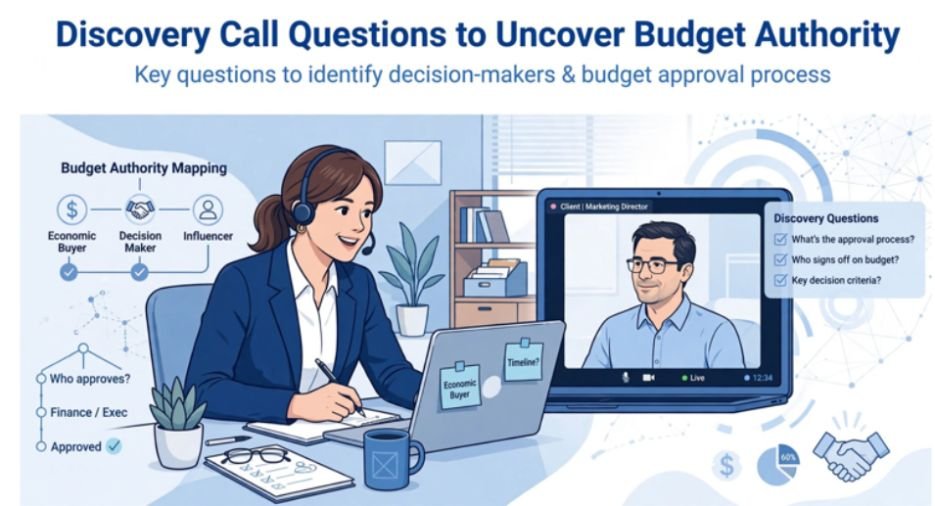
I stopped asking prospects what they want to spend. Instead, I ask what staying broken costs them. These inquiries surface financial scope by anchoring price to operational pain and previous corporate commitments.
| Qualification Focus | Strategic Question | Information Gained |
| Cost of Inaction | “What does it cost your team each quarter in lost billable hours or labor to keep this process manual?” | Establishes the ROI baseline; proves the cost of doing nothing exceeds your software fee. |
| Budget Origin | “Do you have capital set aside for this initiative, or will this require reallocating operational funds?” | Reveals if you are selling against an active line item or competing for discretionary scraps. |
| Historical Precedent | “When your team purchased your last analytics platform, what ballpark investment did leadership sign off on?” | Clarifies organizational price tolerance and past departmental spending benchmarks. |
| Deal Breaker Limits | “At what dollar threshold does an investment in this area trigger an immediate board-level review or a hard ‘no’?” | Identifies your absolute pricing ceiling early in the sales cycle. |
Mapping the Real Decision-Making Matrix
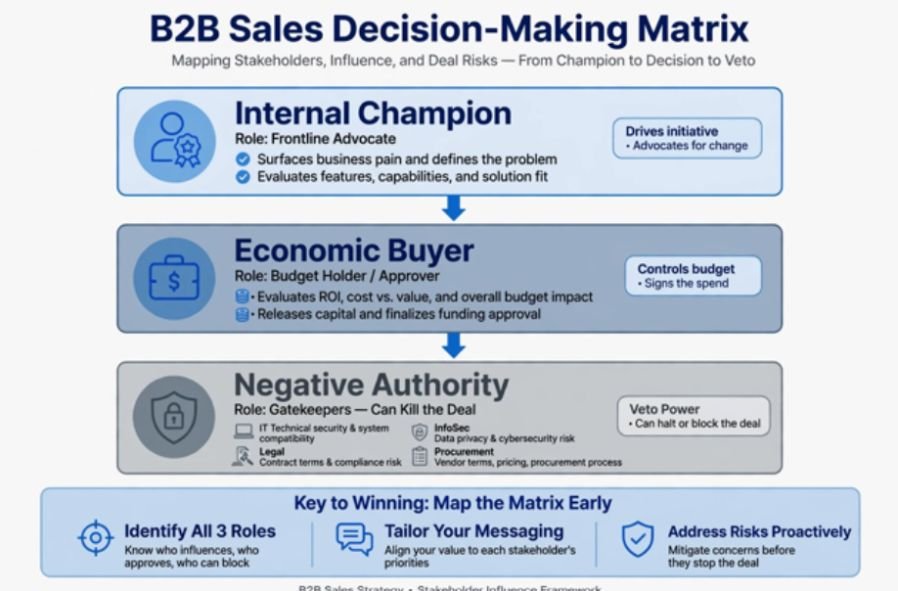
Title inflation is rampant in B2B environments. A Director of Operations might run your weekly syncs, but that does not make them the economic buyer. You must differentiate between a product champion who loves your features and an executive sponsor who actually writes the checks.
[Internal Champion] —> Surfaces Business Pain & Evaluates Features
│
▼
[Economic Buyer] —> Evaluates ROI & Releases Capital
│
▼
[Negative Authority] -> IT / InfoSec / Legal / Procurement (Can Kill the Deal)
Pinpointing the Economic Buyer vs. Champion
To isolate real spending authority, ask where the money lives. I use questions that validate my contact’s importance while uncovering who owns the profit-and-loss sheet:
- “When you finalize your choice, whose departmental budget will actually fund the invoice?”
- “When you presented software investments to your executive team in the past, how did they evaluate the payback window?”
- “Who outside of your immediate team feels this operational headache and will insist on signing off on the contract?”
Surfacing Negative Authority and Procurement Red Tape
A study from the Harvard Business Review notes that purchase friction spikes when buyers struggle to navigate their own internal validation steps. Even if an executive signs an agreement, internal gatekeepers can kill deals on compliance grounds. Uncover these blockers during initial discovery:
- “Once you choose a vendor, what compliance, IT security, or legal reviews must we complete before procurement issues a purchase order?”
- “Who within the team is most protective of the legacy workflow, and what will their primary pushback be?”
Blended Questions: Linking Dollar Thresholds to Individual Sign-Off Power
Every corporate role has a financial boundary. Discovering that ceiling tells you instantly when you must pull leadership into the room.
| Sign-Off Factor | Blended Discovery Question | Deal Impact |
| Discretionary Spending Limit | “What invoice total can you approve independently before needing your VP’s signature?” | Defines deal sizing for your initial land-and-expand proposal. |
| Business Case Metrics | “If this project lands above your personal signature limit, what financial metrics will your CFO demand to justify the delta?” | Gives you the exact playbook needed to build your champion’s business case. |
| Capital Flexibility | “If a solution completely resolves the integration lag, can you reallocate unspent budget from another operational line item?” | Shows whether your deal is dead if your initial quote exceeds an arbitrary number. |
Companies that incentivize sales teams to close larger, multithreaded contracts often structure tiered sales commission plans to reward reps who successfully reach these higher-level economic buyers.
Tactical Execution: Soft Openers and Range Bracketing
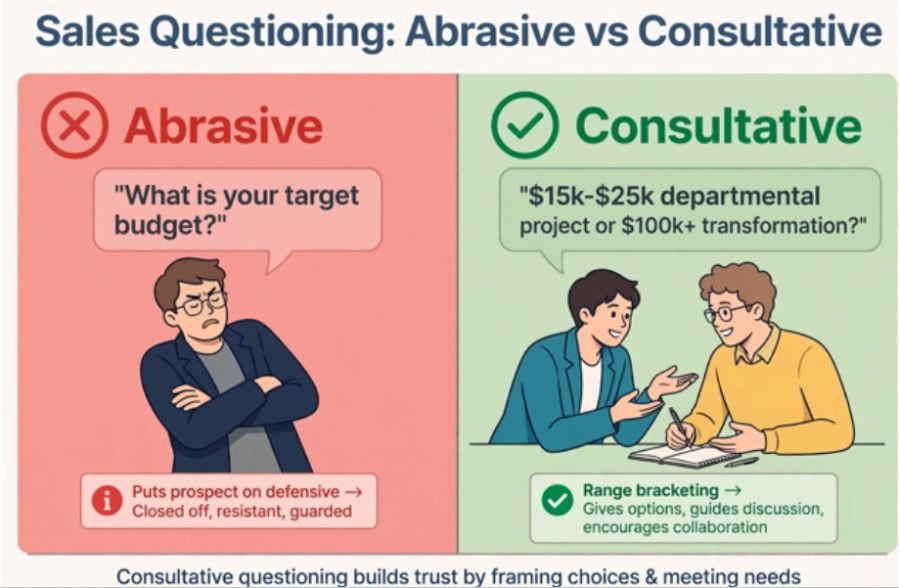
Tone determines whether discovery feels collaborative or intrusive. When a buyer resists sharing financial details, use softeners to establish empathy. Pair those softeners with range bracketing to make responses effortless, a tactic backed by qualifying research from the HubSpot Sales Blog.
Abrasive: “What is your target budget for this roll-out?”
Consultative: “Just to ensure I don’t design an enterprise-tier architecture when all you need is a lean operational starter kit, are we working within a $15,000 to $25,000 departmental project, or is this a $100,000+ cross-functional transformation?”
Bracket broad numbers first. Prospects instinctively correct inaccurate brackets, giving you exact pricing parameters without feeling cornered.
Frequently Asked Questions
1. What should I do if a prospect flatly refuses to share their budget on a discovery call?
Pivot immediately to bracketed pricing ranges to let them validate a general tier without revealing exact numbers.
2. How do I ask about authority without insulting the person I am talking to?
Frame authority around departmental workflows by asking whose cost center funds the tool rather than questioning their rank.
3. At what point in the discovery call should I qualify budget?
Introduce budget questions in the final third of the call, only after uncovering operational pain points and establishing business impact.
4. How can I tell if my champion is misleading me about their purchasing power?
Ask how their team handled their last software purchase; if they cannot describe procurement steps, they lack signing authority.
Stop Selling to Spectators
Qualifying budget and authority is not about filtering out prospects who cannot afford you today. It is about protecting your calendar from deals doomed to die in committee limbo. Deploy these targeted discovery questions early, clarify the internal buying chain before you demo, and never write a proposal for someone who cannot sign the check.