
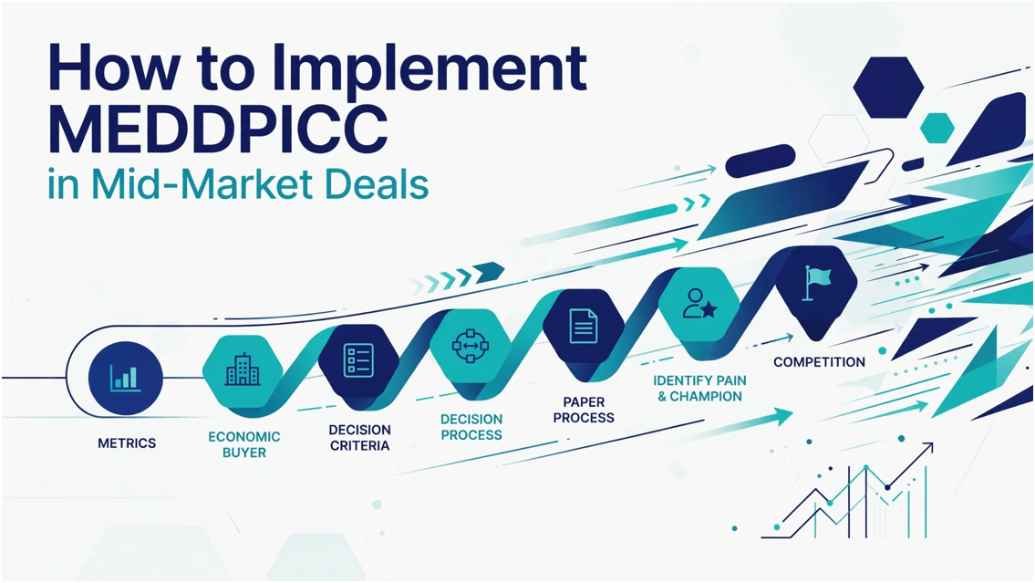
Mid-market deals die when sales teams treat a 45-day sales cycle like a nine-month enterprise procurement slog. When I first introduced the framework to my mid-market account executives, pipeline velocity ground to a halt because reps spent more time completing 20 custom CRM fields than running discovery.
Learning how to implement meddpicc in mid-market deals requires stripping away enterprise overhead while keeping the uncompromising qualification rigor that prevents late-stage deal slippage.
Research from Gartner’s B2B Buying Journey Analysis shows that typical mid-market buying committees comprise four to seven stakeholders rather than the twelve or more seen in large corporations. If you force an AE carrying 30 active opportunities to map out multi-tier procurement boards for a $35,000 deal, they will simply abandon the methodology.
Here is the exact playbook I use to adapt the eight-letter methodology for mid-market deal velocity.
The Mid-Market Dilemma: Enterprise Rigor vs. 45-Day Velocity
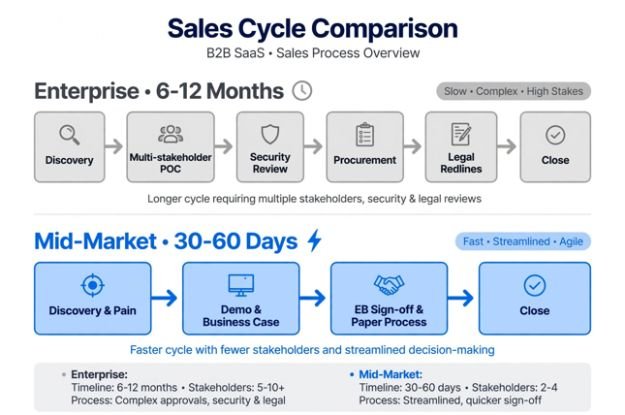
Mid-market deals inhabit an unforgiving middle ground. They move too fast for lengthy security steering committees, yet they are too expensive for transactional, single-call closes.
Enterprise Sales Cycle (6–12 Months):
[ Discovery ] ➔ [ Multi-stakeholder POC ] ➔ [ Security Review ] ➔ [ Procurement ] ➔ [ Legal Redlines ] ➔ Close
Mid-Market Sales Cycle (30–60 Days):
[ Discovery & Pain ] ➔ [ Demo & Business Case ] ➔ [ EB Sign-off & Paper Process ] ➔ Close
When you deploy MEDDPICC in this tier, your primary enemy is not your competitor; it is pipeline stagnation. Mid-market software buyers frequently default to internal spreadsheets or manual workarounds. The framework must therefore function as a fast disqualification engine within the first two calls.
Adapting the 8 Criteria for Mid-Market Deal Cycles
The standard definitions developed by HubSpot’s Sales Qualification Experts need to be streamlined for smaller deal sizes. Rather than building complex multi-variable financial models, you must focus on immediate, tangible business metrics.
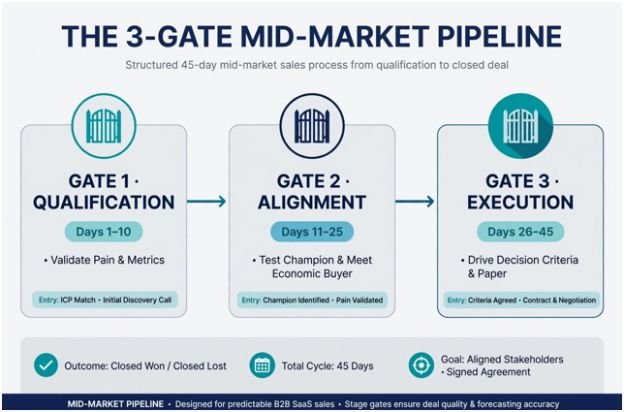
The Mid-Market MEDDPICC Matrix
To run high-velocity cycles, compress the eight letters into actionable mid-market equivalents:
| Element | Enterprise Focus | Mid-Market Velocity Focus | Red Flag to Avoid |
| Metrics (M) | Multi-year corporate transformation | Immediate labor or operational savings (e.g., 8 hours/week saved) | Over-engineering complex financial ROI models |
| Economic Buyer (EB) | C-suite board member or corporate EVP | Department head, VP, or Director with discretionary spend | Relying on an enthusiastic end-user who cannot sign |
| Decision Criteria (DC) | Exhaustive vendor matrices with 100+ points | Top 3–5 functional must-haves and immediate integrations | Allowing IT to introduce enterprise scope creep |
| Decision Process (DP) | Formal RFP and cross-functional evaluations | 2 to 3-week direct review with department leadership | Relying on a verbal “we love it” without calendar dates |
| Paper Process (PP) | Multi-round redlines across external counsel | Mutual execution of standard vendor MSA and Order Form | Waiting until week five to ask about legal review |
| Identified Pain (I) | Macro-level strategic risk or regulatory shifts | Acute, daily friction causing lost revenue or churn | Pitching to generic “efficiency” goals |
| Champion (C) | Highly political influencer with broad capital | Functional manager who feels the pain every single day | Confusing a chatty contact for an internal mobilizer |
| Competition (C) | Direct Tier-1 enterprise software competitors | The status quo, manual spreadsheets, or doing nothing | Underestimating internal inertia |
Step-by-Step Playbook: Deploying MEDDPICC Without Slowing Down AEs
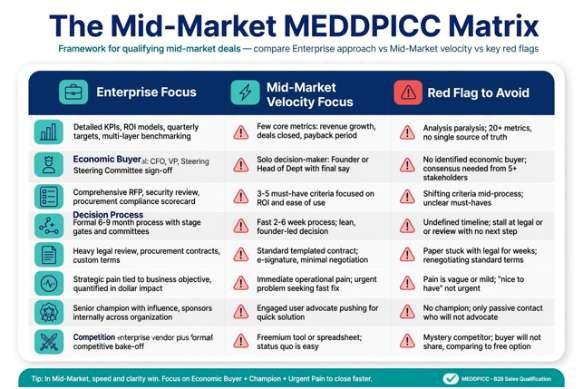
Do not train your reps to tackle all eight components simultaneously. Break your 30-to-60-day cycle into three discrete gates.
+———————————————————————————–+
| THE 3-GATE MID-MARKET PIPELINE |
+————————————+———————————————-+
| Gate 1: Qualification (Days 1–10) | Validate Pain (I) & Tangible Metrics (M) |
| Gate 2: Alignment (Days 11–25) | Test Champion (C) & Meet Economic Buyer (EB)|
| Gate 3: Execution (Days 26–45) | Drive Decision Criteria (DC) & Paper (PP) |
+————————————+———————————————-+
Gate 1: Pain and Metrics Validation (Calls 1 & 2)
In the initial discovery call, uncover the acute operational drag. Quantify that drag in direct currency or recovered hours. If an account executive cannot define what fails if the customer remains on their current workflow by call two, disqualify or deprioritize the opportunity.
Ask: “If you do not solve this problem this quarter, what breaks in your workflow, and what does that cost you monthly?”
Gate 2: Aligning the Economic Buyer and Champion (Calls 3 & 4)
In mid-market sales, you rarely negotiate with an inaccessible buying board. The Economic Buyer is often one level above your Champion. Use your Champion to access the budget owner before delivering a commercial proposal.
Test your Champion with an explicit assignment: “Can you introduce us to your VP of Finance so we can align our onboarding schedule with their quarterly budget review?” If they refuse, you have a coach, not a champion.
Gate 3: Collapsing the Paper and Decision Process
Never let the contract become an afterthought. The moment the technical demo succeeds, send your standard agreement for parallel legal review. Research published by the Harvard Business Review on Sales Discipline highlights that administrative drag late in the cycle reduces close probabilities by up to 24%.
Use a Mutual Action Plan (MAP) that establishes the target go-live date and maps backward to contract execution.
Target Go-Live: October 1
└── System Onboarding Starts: September 15
└── Contract Signed (Paper Process Complete): September 1
└── Final Security / Legal Review: August 20
Operationalizing MEDDPICC in Your CRM and Pipeline Reviews
Avoid cluttering your CRM with endless open-text boxes. Configure your sales pipeline stages to enforce objective verification:
- Stage 2 (Discovery Complete): Requires quantified Pain (I) and baseline Metrics (M).
- Stage 3 (Evaluation): Requires a named Champion (C) and confirmed Decision Criteria (DC).
- Stage 4 (Negotiation): Requires direct contact history with the Economic Buyer (EB) and marked status on the Paper Process (PP).
Frontline sales managers should run deal inspections centered on what I call the E-P-C velocity anchor:
- Economic Buyer: Have we verified the signer’s identity and fiscal sign-off threshold?
- Paper Process: Are we executing on our paper or undergoing external legal redlines?
- Champion: Has our internal contact delivered access or internal documentation?
Use this inspection rhythm when you run effective weekly sales one-on-ones to eliminate pipeline friction early. Once your sales team masters this framework, pass those validated pain points and operational metrics directly to post-sales leaders.
Ditch the Hope Strategy and Build Predictable Pipeline
Mid-market sales velocity thrives on rapid deal clarity, not hopeful waiting. Adapting MEDDPICC for mid-market deals gives your sales organization a surgical instrument to cut dead opportunities from your pipeline within 14 days.
You free your account executives to focus entirely on deals with verified economic buyers, painful problems, and unambiguous contract paths. Strip away the enterprise bloat, enforce your three gates, and inspect evidence rather than optimism. This handoff fuels an account expansion and cross-selling framework for ams long after the initial signature.
Frequently Asked Questions About Mid-Market MEDDPICC
1. What is the biggest difference between enterprise and mid-market MEDDPICC?
Mid-market cycles emphasize rapid operational ROI and streamlined standard paper instead of multi-tiered procurement committees and complex financial models.
2. Can mid-market AEs manage all eight MEDDPICC fields without administrative burnout?
Yes, provided you implement simplified CRM picklists and tie qualification updates directly to key stage advancements.
3. How do you identify a true champion in a 30-day deal?
A true champion actively tests their internal capital by sharing internal budget memos and arranging direct access to the economic buyer.
4. When should you disqualify a mid-market deal using MEDDPICC?
Disqualify by the end of the second call if you cannot uncover an acute, quantifiable pain point or establish access to the decision-maker.