

Most account management teams spend 80% of their energy defending contracts rather than growing them. Early in my career managing enterprise SaaS portfolios, I treated renewals as my finish line. That mistake cost my team millions in missed net revenue retention.
True revenue security comes from an intentional account expansion and cross-selling framework for ams that converts customer success into compounding pipeline. If you want sustainable growth, you must stop waiting for client purchase orders and start orchestrating them.
The Economics of Turning Account Managers Into Revenue Engines
Customer acquisition costs continue to climb across enterprise verticals. Research from Bain & Company shows that increasing customer retention rates by just 5% can increase profits by 25% to 95%. Yet, many organizations still treat account managers as reactive customer support representatives with sales quotas.
When your team relies solely on inbound feature requests to generate new pipeline, expansion revenue becomes accidental. Real scale demands structured account exploration.
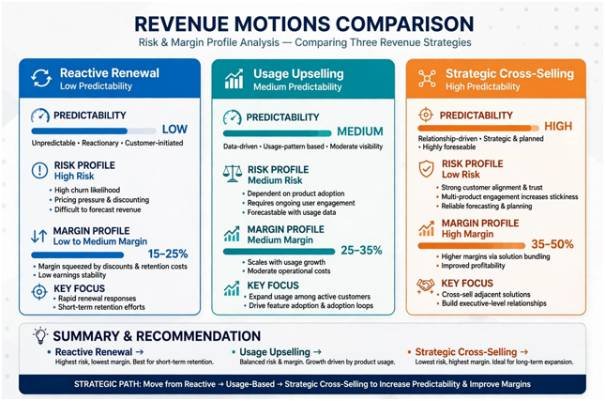
| Revenue Motion | Revenue Predictability | Primary Commercial Risk | Margin Profile |
| Reactive Renewal | Low (Vulnerable to sudden churn) | Churn, downsell, budget cuts | Low (High maintenance overhead) |
| Usage Upselling | Medium (Tied directly to consumption) | Headcount freezes, seat audits | Moderate (Linear expansion) |
| Strategic Cross-Selling | High (Multi-department integration) | Long sales cycles, budget fragmentation | High (Compound platform stickiness) |
A formal framework gives account managers the authority to run commercial conversations without compromising their advisory relationships.
The 4-Pillar AM Expansion Framework
Building a dependable expansion engine requires operational discipline across health signals, whitespace analysis, commercial timing, and structured procurement terms.
┌─────────────────────────────────────────────────────────┐
│ 1. DATA & HEALTH AUDIT (Identify the Right Signals) │
└────────────────────────────┬────────────────────────────┘
│
▼
┌─────────────────────────────────────────────────────────┐
│ 2. WHITESPACE MAPPING (Discover the Unmapped Revenue) │
└────────────────────────────┬────────────────────────────┘
│
▼
┌─────────────────────────────────────────────────────────┐
│ 3. THE TRIGGER EVENT MATRIX (Time the Pitch Perfectly) │
└────────────────────────────┬────────────────────────────┘
│
▼
┌─────────────────────────────────────────────────────────┐
│ 4. THE COMMERCIAL PLAYBOOK (Execute the Expansion) │
└────────────────────────────┘
Pillar 1: Health Audits and the Day 90–240 Window
Never pitch new products to an account struggling with baseline adoption. Attempting to cross-sell to an unhappy stakeholder erodes trust instantly.
I use three concrete gates to verify commercial readiness:
- License utilization consistently exceeds 80%.
- The account logs zero unaddressed Tier-1 support tickets over the prior 60 days.
- The original business case has recorded measurable return on investment signed off during a business review.
Timing matters as much as adoption metrics. A study documented by Harvard Business Review highlights that poorly managed cross-selling alienates valuable customers when misaligned with genuine client priorities.
Pitching an add-on product within 60 days of renewal signals desperation and invites procurement pushback. I coach my teams to execute expansions strictly within the Day 90 to Day 240 window of an annual contract. This timing keeps expansion discussions focused on strategic progress rather than contract defense.
Pillar 2: Strategic Whitespace and Multi-Product Mapping
Whitespace mapping clarifies the distinction between selling more usage and selling new business capabilities. Account managers frequently confuse up-selling with cross-selling, which stalls multi-product momentum.
| Dimension | Up-Selling Motion | Cross-Selling Motion |
| Core Objective | Expand depth within current scope | Expand breadth into adjacent teams/use cases |
| Target Buyer | Current Operational Admin / Champion | Department Head, New VP, or Parallel Director |
| Primary Metric | Storage limits, API tiers, seat count | New distinct modules, platform editions |
| Buying Trigger | Capacity alerts, licensing overages | Corporate restructuring, new corporate OKRs |
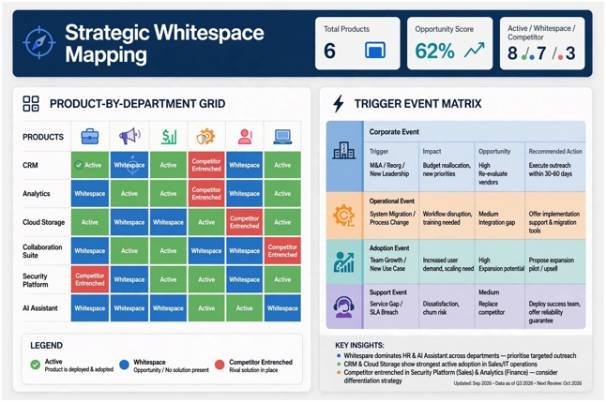
Map every tier-1 account across a product-by-department grid. Label each cell as Active, Whitespace, or Competitor Entrenched.
When accounts enter your portfolio via a clean account executive and sdr handoff process, that initial documentation reveals adjacent departments and software stacks. Reviewing this baseline data uncovers clear cross-sell opportunities without requiring cold discovery from scratch.
Pillar 3: Corporate and Behavioral Trigger Events
Great account managers avoid pitching on arbitrary calendar dates. Instead, they align conversations with specific corporate and operational shifts. Gartner research underscores that commercial customer interactions succeed most when sellers surface situational challenges the customer has not yet prioritized.
| Trigger Category | Observed Event | Recommended AM Action |
| Corporate Event | New VP or C-level hire joins department | Schedule an executive vision alignment session within 45 days. |
| Operational Event | Regional or business unit acquisition | Present multi-entity licensing to consolidate fractured tool stacks. |
| Adoption Event | Client hits 85% feature limit consistently | Propose tiered enterprise migration to eliminate usage throttling. |
| Support Event | Repetitive custom workflow tickets filed | Demonstrate a specialized add-on module built to solve that workflow. |
Monitoring these operational moments helps account managers show up with solutions precisely when strategic budgets open up.
Pillar 4: Commercial Execution and De-Risked Pilots
Commercial friction kills cross-sells. When an account manager approaches an existing customer with a separate contract, different terms, and a disconnected renewal date, procurement will delay the deal.
Remove friction by using three tactical methods:
First, co-term every expansion deal. Always pro-rate add-on modules so they terminate on the master contract’s existing renewal date. Single-invoice billing keeps approvals simple.
Second, use unilateral trial addendums. If an operational leader hesitates to purchase an adjacent module, draft an opt-out pilot addendum. Grant 30 days of production access tied to clear success criteria. If the platform meets those criteria, the agreement automatically converts to a paid term unless cancelled in writing before Day 30.
Third, trade concessions intentionally. Never offer baseline discounts to close an add-on. If an enterprise customer demands a 15% discount on a cross-sold analytics module, exchange that discount for a multi-year master contract extension.
Putting the Pipeline into Motion
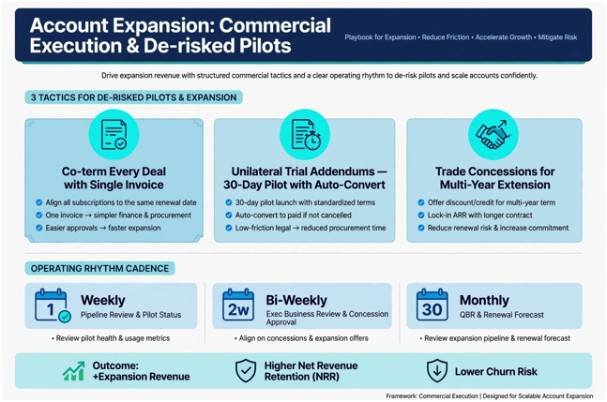
Frameworks fail without weekly operating rhythms. Frontline leaders need to review pipeline activity often enough to guide stalled multi-threading efforts.
Use these managerial cadences to keep account managers accountable to expansion targets:
| Frequency | Review Focus | Core AM Deliverable |
| Weekly | Trigger matrix reviews and pending renewals | 3 account trigger analyses per AM |
| Bi-Weekly | Multi-threading strategy across tier-1 logos | Stakeholder map showing new executive contacts |
| Monthly | Portfolio whitespace coverage and co-terming math | Updated account-by-product whitespace grids |
Sales leaders who run effective weekly sales one-on-ones keep their account managers locked on leading indicators rather than scrambling during renewal season.
Frequently Asked Questions
1. What is the primary difference between up-selling and cross-selling for account managers?
Up-selling expands existing license tiers or consumption volumes, while cross-selling introduces completely new product lines or adjacent capabilities to different budgets.
2. When should an account manager avoid pitching an account expansion?
Never pitch expansions within 60 days of renewal or when client adoption sits below 80% with unresolved support tickets.
3. How do account managers successfully multi-thread into new client departments?
Leverage your internal champion by exchanging verified ROI metrics for warm introductions to adjacent department leaders facing related operational bottlenecks.
4. What is the most effective commercial incentive for an enterprise expansion?
Co-terming add-ons to the master contract anniversary date eliminates separate legal cycles and simplifies procurement approvals.
Stop Defending Contracts and Start Growing Them
Renewals only preserve your past; deliberate expansion creates your future. If your account managers spend their weeks checking in on user sentiment, they are acting as customer service reps with a sales title.
Audit your top 10 enterprise accounts today. Map their technical whitespace, check their license utilization, and pick two triggers to act on before the end of the week. Expand your footprint, integrate deeper into your clients’ operations, and build renewals that happen automatically.