


I used to dread my calendar on Mondays. Eight back-to-back one-on-ones that felt like status updates. My reps hated them too. Then I flipped the format. I learned how to run effective weekly sales one-on-ones as coaching sessions, not interrogations, and everything changed. This is the exact blueprint I use now.
Most managers waste the highest-leverage 30 minutes of their week gathering context they should already know. I did. Stop.
Why Most Sales One-on-ones Fail
They fail because we make them about us. We ask for pipeline updates we could pull from the CRM. That triggers defensiveness and kills coaching.
Harvard Business Review research shows that quality coaching interactions drive performance far more than pipeline scrutiny alone. Salesforce also emphasizes that regular, structured one-on-ones increase rep engagement when focused on development, not just numbers.
I learned this the hard way. When I stopped asking “where is this deal?” and started asking “why do you think this stalled?”, my reps started solving their own problems.
If you want to scale that coaching culture, you also need to align incentives. I found it easier to coach when I had already decided how to structure tiered sales commission plans to reward the behaviors we were coaching.
The 10-Minute Pre-Meeting Ritual I Never Skip
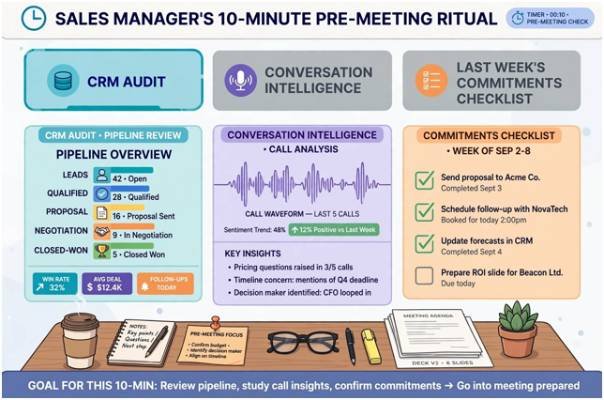
I never improvise. Ten minutes before each rep, I do a focused audit. This lets me spend the actual meeting on solutions.
What I Actually Review
I open three tabs only. CRM for stage hygiene and KPI gaps. Conversation intelligence for one win and one risk call. And last week’s notes for commitments.
This pre-work is non-negotiable. HubSpot’s sales management data confirms managers who prepare with data drive more actionable coaching.
| Pre-Work Item | What I Look For | Time |
| CRM Audit | Deal stuck >14 days, no next step, KPI vs target | 4 mins |
| Call Snippet | 1 objection handling moment, 1 pricing moment | 3 mins |
| Last Week’s Commitment | Did they do the 1-2 behaviors they promised? | 3 mins |
My 30-Minute High-Impact Agenda That Works
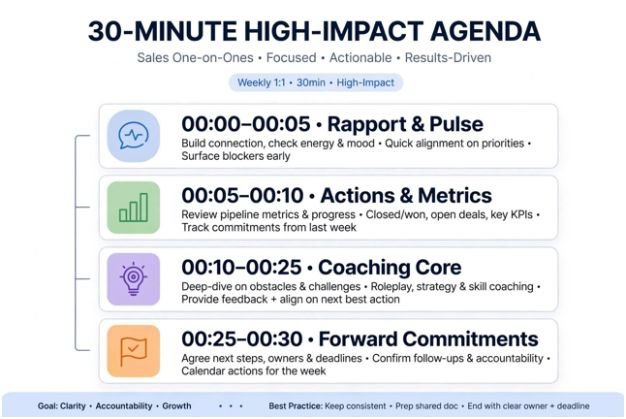
Predictability builds trust. My team knows this flow cold.
| Time Block | Purpose | My Role |
| 00:00-00:05 | Rapport & Pulse | Listen 80% |
| 00:05-00:10 | Actions & Metrics | Cross-check |
| 00:10-00:25 | Coaching Core | Ask, don’t tell |
| 00:25-00:30 | Commitments | Scribe |
00:00 – 00:05 Rapport & Pulse Check
I start with “How are you doing?” Then I ask it again. The second answer is the real one. I ask for one win first. If they can’t name it, I pull one from their data. Recognition fuels momentum.
00:05 – 00:10 Last Week’s Commitments & Metrics
We review last week’s homework in 60 seconds. Did they execute the target activities? Then we glance at core metrics. I frame gaps as skill opportunities. Zendesk’s sales leadership guide notes that framing performance gaps as improvement areas prevents defensiveness.
00:10 – 00:25 The Coaching Core
This is 15 minutes of pure leverage. I apply the 80/20 rule. We do not review 20 deals. We pick one high-impact deal and one skill.
I use the pull approach. Instead of “Do this,” I ask “Why do you think this deal stalled at evaluation? What would a perfect fallback plan look like?” They diagnose. My close rate on coached deals went from 31% to 53% when I stopped giving answers.
This focus is also how I help reps shorten enterprise sales cycles. We don’t coach generic discovery; we coach the specific bottleneck in one enterprise deal.
For call feedback, I use max 2-3 corrections. Start positive, correct, end encouraging. Always cite a specific behavior you heard.
00:25 – 00:30 Forward Commitments
We end with clarity. The rep states their plan in their own words. I log 1-2 behavioral commitments in our shared tracker. No vague promises. Example: “I will re-engage Acme and Beta with mutual close plans by Wednesday.”
3 Rules That Changed Everything For My Team
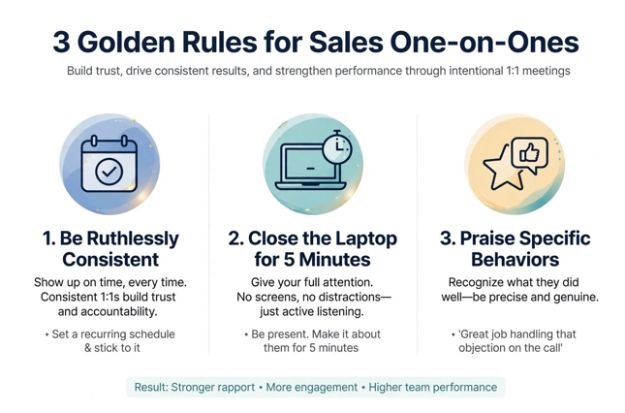
- Treat it as a contract. I never cancel for admin work. If I must move it, I reschedule within 24 hours. Consistency equals safety.
- Close the laptop for 5 minutes. I make eye contact early. No screen between us until we hit metrics. Active listening matters more than notes.
- Praise the controllable. I praise how they handled an objection, not that they got lucky and closed. Behavior repeats when recognized.
Tools and Reference Framework
| Framework | Source & Why I Trust It |
| Coaching > Interrogation | HBR on effective coaching conversations |
| Structured 1:1s increase engagement | Salesforce sales management best practices |
| Data-driven prep | HubSpot sales coaching research |
| Improvement-focused feedback | Zendesk sales one-on-one guide |
Stop Running Status Meetings and Start Coaching Revenue
Your weekly one-on-ones are not a pipeline report. They are a behavior change lab. Do the 10-minute prep, run the 30-minute block, and enforce the 1-2 commitments.
My team hated Mondays before. Now they protect this time. Try my agenda with one rep this week and measure the difference in their next call.
FAQs
1. How long should weekly sales one-on-ones be?
Keep it to 30 minutes with 10 minutes of prep; 45 minutes max for enterprise reps.
2. What is the best agenda for sales one-on-ones?
5 mins rapport, 5 mins metrics review, 15 mins skill and deal coaching, 5 mins commitments.
3. How do you make sales one-on-ones less awkward?
Use a predictable agenda, start with wins, and ask questions instead of interrogating pipeline.
4. Should I review every deal in a one-on-one?
No, focus on the top 20% of deals that drive 80% of revenue and coach one skill.

2 thoughts on “How to Run Effective Weekly Sales One-on-ones”