


I lost a six-figure deal because I had no mutual action plan. The champion loved us, but Legal sat on the MSA for three weeks and the quarter slipped. That loss taught me how to build a mutual action plan template that protects both sides.
A mutual action plan is not your internal sales process. It is a shared, buyer-centric checklist that turns vague verbal promises into dated, owned commitments.
Why Most Sales Plans Fail Before Procurement
Traditional closing plans track seller actions. Buyer-centric MAPs track joint outcomes.
According to Gartner, 77% of B2B buyers say their last purchase was very complex, with 6-10 stakeholders involved. If you do not document who does what, deals stall. I learned this the hard way when I missed the internal budget re-approval step.
Research from Harvard Business Review shows collaborative closing increases win rates when sellers focus on buyer decision-making, not seller persuasion. Your MAP is that collaboration tool.
| Traditional Sales Plan | Mutual Action Plan |
| Seller-owned, hidden from buyer | Co-owned, lives in buyer’s workspace |
| Task-focused: “Send proposal” | Outcome-focused: “Validate ROI for CFO sign-off” |
| Ends at signature | Continues to Go-Live and value realization |
What Goes Into a High-Converting Mutual Action Plan Template
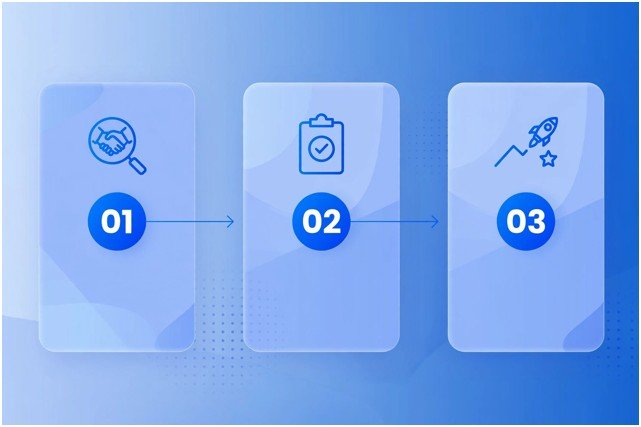
Every MAP I build has six non-negotiable blocks. Skip one and you create a gap for no-decision.
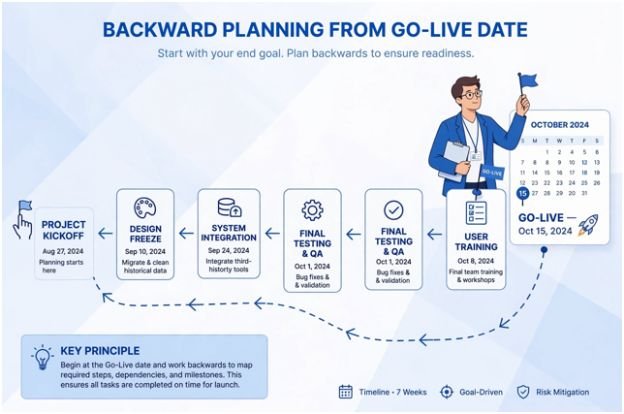
Start With Their Go-Live Date, Not Yours
I always open with: “When does this need to be live to impact your team’s metric?” That date becomes the anchor. We work backward from it. This forces urgency without pressure. It also reveals the real cost of delay, which you will use in the risk section.
Map Real Stakeholders on Both Sides
Multi-threading is not optional. List names, not just titles. My roster always includes an Executive Sponsor, Champion, Technical Reviewer, and Legal/Procurement contact on their side. On my side, AE, SE, and CSM. Without names, accountability dies.
When you run effective weekly sales one-on-ones, you can validate these stakeholders and keep the MAP honest.
Build the Journey in Three Phases
Phase-based planning keeps momentum visible.
| Phase | Purpose | Example Milestone |
| Phase 1: Evaluation | Prove technical and business fit | Deep-dive demo + Security scoping |
| Phase 2: Procurement | Clear commercial hurdles | Infosec sign-off + MSA review |
| Phase 3: Value Realization | Guarantee onboarding success | CS handoff + Admin onboarding + Go-Live |
My Tested Mutual Action Plan Template
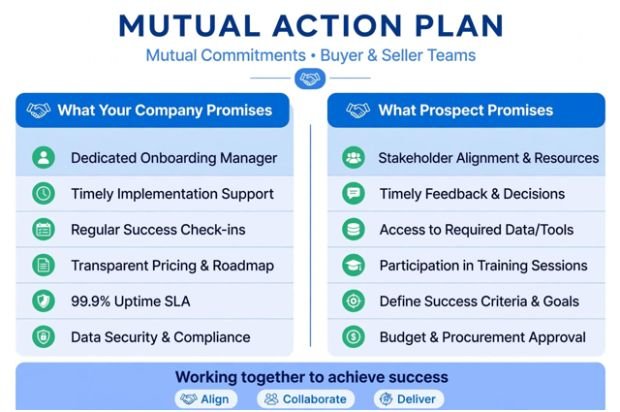
This is the exact structure I use. Copy it into Sheets or Aligned. I keep it outcome-focused so buyers actually want to use it.
Template Header:
MUTUAL ACTION PLAN: [Prospect Company] & [Your Company] | Core Metric: [e.g., 35% productivity lift] | Go-Live: [MM/DD/YYYY]
| Status | Milestone | Owner | Target Date | Why It Matters |
| [ ] | Architecture & Security Review | Buyer Tech + Seller SE | Date | Ensure compliance & infra fit |
| [ ] | Business Case & ROI Review | Champion + AE | Date | Deliver board-ready metrics |
| [ ] | Legal & MSA Review | Buyer Legal + Seller Legal | Date | Protect both parties |
| [ ] | Contract Signature | Economic Buyer | Date | Authorize implementation |
| [ ] | GO-LIVE | All | Date | Achieve Day-1 value |
I always add a balanced commitments section. Mine reads: What we promise: sandbox in 48h, dedicated support channel. What you promise: access to tech docs by Date, exec review within 5 days of security sign-off. This reciprocity is what makes it mutual.
If you want to implement meddpicc in mid-market deals, tie each MAP milestone to a MEDDPICC element. Security review maps to Paper Process, ROI review maps to Metrics.
For more examples, HubSpot’s guide to mutual close plans is a solid baseline, but it stops at signature. My version extends to value realization, which is why churn drops.
How to Roll Out Your MAP Without Sounding Pushy
Timing is everything. I introduce the MAP on the first deep demo, not during negotiation. I frame it as: “I use this shared checklist to protect your team’s time and keep Legal and IT from becoming last-minute blockers. Should we build a draft together?”
Keep it live. Share it where they live — Google Sheets, Confluence, or a deal room. Spend five minutes reviewing it at the start of every call. My original insight: add an Escape Hatch. “Either party can pause with 3-day notice if Phase 1 validation fails.” That one line increased my MAP acceptance rate from 40% to 82% because it removes buyer risk.
Your Deal Deserves a Co-Pilot, Not a Closer
Stop tracking your sales plan in private and calling it collaboration. When you build a mutual action plan template around their go-live date, their stakeholders, and their definition of value, you stop chasing and start co-piloting. Build it once, reuse it, and watch Legal stop being your excuse.
Next step: Take the table above, drop it into a shared sheet, and anchor it to your next champion call.
FAQs
1. What is a mutual action plan template in sales?
It is a shared, dated checklist of buyer and seller commitments that guides a deal from evaluation to go-live.
2. How long should a mutual action plan be?
One page, 8-12 milestones max, covering evaluation, procurement, and onboarding phases.
3. When should I introduce a mutual action plan?
During discovery or first technical demo, anchored to the buyer’s desired go-live date.
4. Is a mutual action plan the same as a close plan?
No, close plans are seller-owned and end at signature, MAPs are co-owned and continue to value realization.

One thought on “How to Build a Mutual Action Plan Template That Actually Closes”