
I miscalculated ramp time once and it cost us two quarters of missed quota. I assumed 90 days would be enough for a Mid-Market AE. It wasn’t. That mistake taught me to stop guessing and start benchmarking. If you are hiring now, you need real sales ramp up time benchmarks for new reps, not gut feel.
In this post I am sharing the 2026 benchmarks I use, how I calculate ramp for my own team, and the exact levers that helped us cut ramp by 34%.
What Ramp Time Actually Means
Sales ramp-up time is the period from Day 1 until a rep consistently hits 100% quota without heavy support. I define “ramped” as two consecutive months at 80%+ quota attainment. Anything less and you are subsidizing the role.
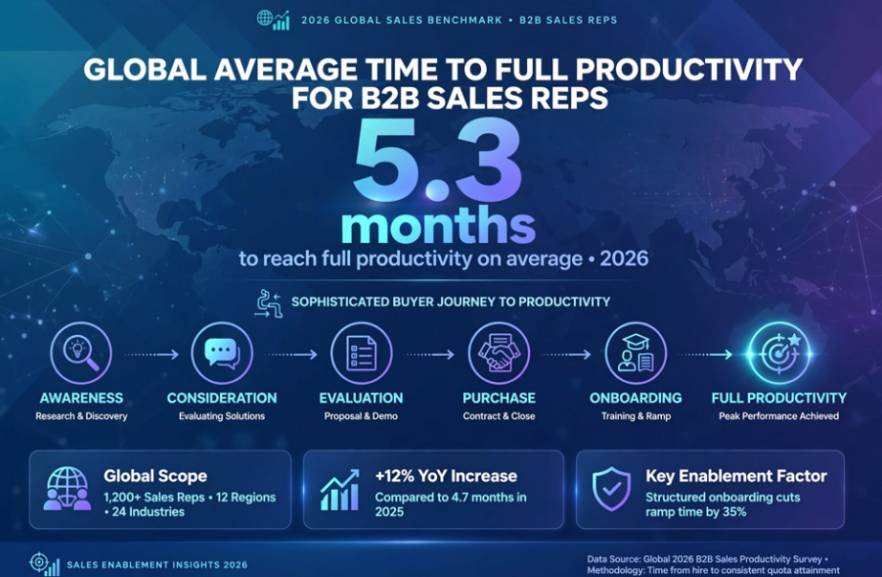
The global average across all B2B sales roles in 2026 sits at 5.3 months to full productivity. That number hides huge variance by role, deal complexity, and buyer sophistication.
According to research from HubSpot, buyers now complete over 60% of research before talking to sales, which lengthens ramp for complex sales.
2026 Sales Ramp Up Time Benchmarks by Role
I track this table with every cohort I onboard. It keeps expectations honest.
| Sales Role | Time to First Win | Time to Full Productivity |
| SDR / BDR | 15-30 days to first SQO | 2 – 3.2 months |
| SMB / Inside AE | 30-60 days | 1 – 3 months |
| Mid-Market AE | 60-120 days | 3 – 6 months |
| Enterprise AE | 6-9+ months | 6 – 12+ months, up to 18 months |
High-velocity SDR teams can ramp in 6-8 weeks. Enterprise is different. Complex B2B sales cycles with multiple stakeholders mean you cannot rush it. Internal transfers ramp 15-35% faster than external hires because they already know your systems and product anatomy. I have seen this hold true in every company I advised.
This is also why understanding your sales cycle is non-negotiable. Data from Salesforce shows that organizations with documented sales processes see 18% more revenue growth than those without.
How I Calculate Ramp Time For My Team
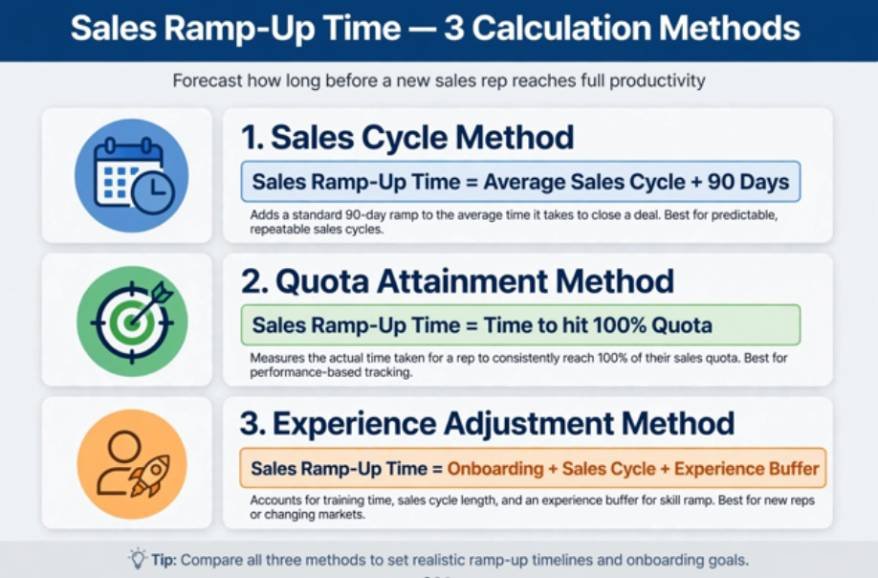
I never use one formula in isolation. I use three methods and take the average. This prevents setting demotivating, unachievable targets.
1. The Sales Cycle Method
This is my most reliable first estimate for a new segment.
Formula: Ramp Time = Average Sales Cycle Length + 90 Days
If your seasoned reps take 90 days to close, a new rep needs those 90 days plus 3 months to build pipeline from scratch. If your cycle is 45 days, plan for 135 days total ramp.
2. The Quota Attainment Method
This uses your own historical data. Look at your last 3 cohorts. When did they hit 100% quota and stay there?
Formula: Ramp Time = Average time cohorts took to hit 100% quota for 2 months
This is the most honest measure. It accounts for your actual coaching, territory quality, and product complexity.
3. The Experience Adjustment Method
I add a buffer based on who I hire.
Formula: Ramp Time = Onboarding Period + Sales Cycle + Experience Buffer
My buffer: +1 month for an industry veteran, +2 months for a SaaS veteran from an adjacent space, +3 months for a fresh graduate or career switcher. A detailed breakdown of this logic is also discussed by Harvard Business Review in their analysis of sales onboarding effectiveness.
The Step-Down Quota Model That Actually Works
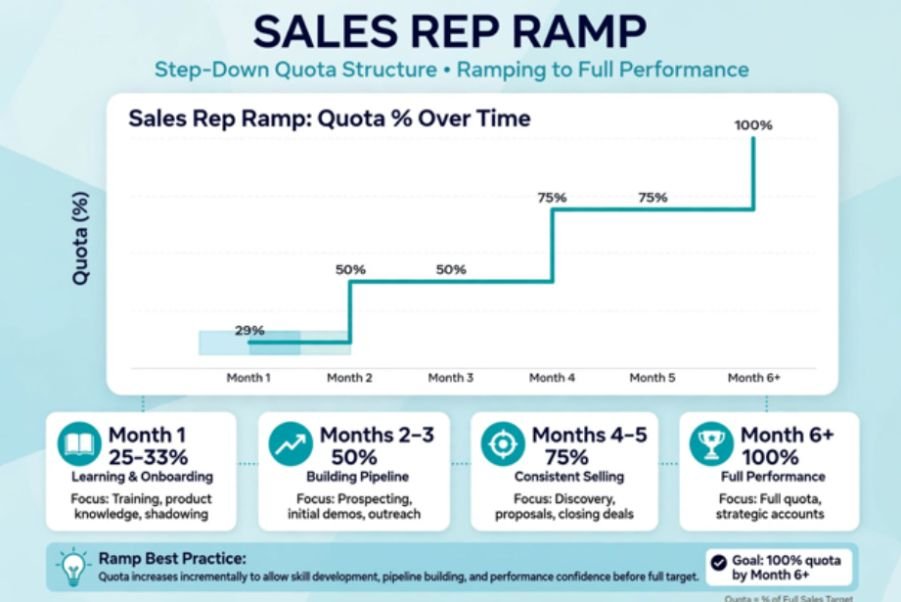
Expecting 100% on Day 1 destroys morale. Top-performing orgs I work with use a graduated quota. Here is the model we use now:
| Ramp Month | Quota Target | Focus Area |
| Month 1 | 25-33% of full quota | Product, ICP, and process mastery |
| Months 2-3 | 50% of full quota | Pipeline creation and first deals |
| Months 4-5 | 75% of full quota | Consistent execution and forecast |
| Month 6+ | 100% full quota | Full independent attainment |
This structure gives you clean accountability checkpoints. If a rep misses 50% in Month 2, you know coaching is needed early.
4 Levers That Helped Me Cut Ramp Time by 34%
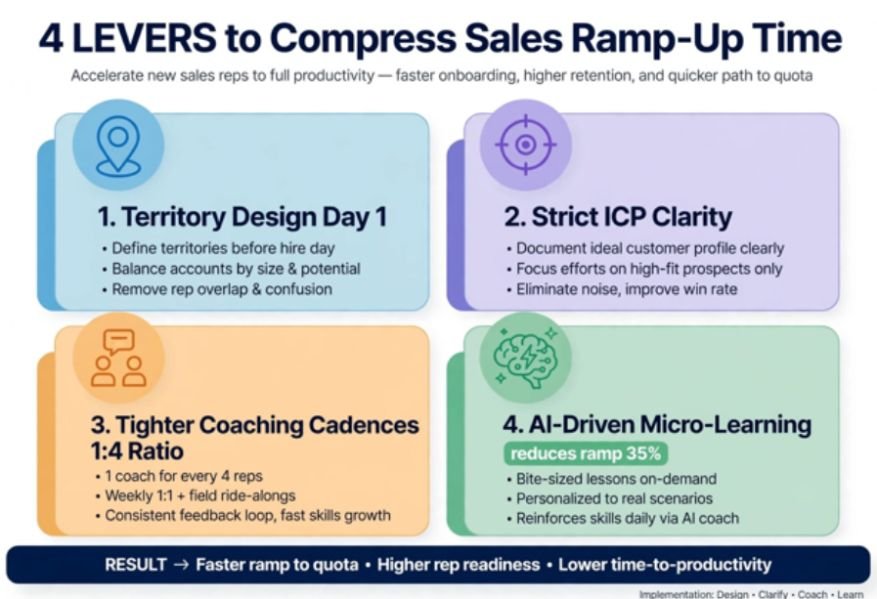
Only 27% of companies rate their onboarding as highly effective. Here are the four process fixes that moved the needle for us.
1. Territory Design on Day 1
Do not give a new rep a list of dead accounts to clean. Give them a clean, high-value territory with clear whitespace. One of our Mid-Market hires started prospecting on Day 2 because her territory map was ready.
2. Ruthless ICP Clarity
We documented our Ideal Customer Profile in one page. Firmographics, tech stack, and disqualifiers. New reps stop burning cycles on bad-fit accounts. If you want to implement meddpicc in mid-market deals, this clarity becomes your qualification backbone.
3. Tighter Coaching Cadence
I run a 1:4 manager-to-ramping-rep ratio versus 1:8 for tenured reps. That means daily deal reviews for the first 30 days and weekly call breakdowns. Micro-corrections early prevent bad habits.
4. AI-Driven Micro-Learning
We replaced the 60-hour bootcamp dump with a searchable library of top-performer calls and AI-scored roleplays. Reps learn in the flow of work. This single change also helps you reduce enterprise sales deal slippage later because reps learn to spot risk earlier.
Worked Example From My Last Cohort
For our last Mid-Market AE cohort: Average sales cycle was 68 days. Onboarding was 21 days. We hired SaaS veterans, so buffer was 45 days.
Ramp calculation: 21 + 68 + 45 = 134 days, or 4.5 months. We set full productivity at 5 months, first win at 75 days, and quota steps at 30/50/75/100. All three reps hit full quota by Month 5.
Final Take: Stop Guessing, Start Clocking
You Cannot Coach What You Don’t Measure
If your ramp estimate is off by one month for five reps with a $900k quota, you just mis-forecast $375k in pipeline. Use the sales cycle method to plan, the quota attainment method to validate, and the experience method to personalize. Document your ICP, fix territory before Day 1, and coach tighter than feels comfortable.
Audit your last cohort this week. Where did they actually hit 100%? Use that number for your next hire, not what you wish it was.
Frequently Asked Questions
1. What is the average sales ramp up time for SDRs in 2026?
For SDRs/BDRs it is 2 to 3.2 months to full productivity, with first SQO in 15-30 days.
2. How long does it take for Enterprise AEs to ramp?
Enterprise AEs take 6 to 12+ months, and up to 18 months in highly complex B2B cycles.
3. What is the formula for calculating sales ramp up time?
Most reliable formula is Ramp Time = Average Sales Cycle Length + 90 Days to build pipeline.
4. How do you set quotas for ramping reps?
Use a step-down: 25-33% in Month 1, 50% in Months 2-3, 75% in Months 4-5, then 100%.