
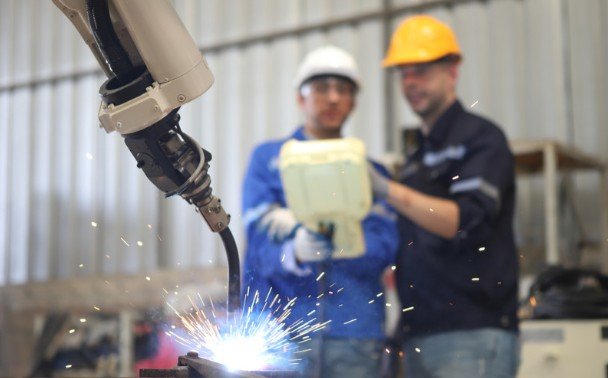
I used to think welding productivity depended almost entirely on the power source, consumables, and operator technique. Those elements remain important, but they reveal only part of what happens during production. Without reliable operating data, supervisors may not notice recurring voltage deviations, lost arc time, or developing equipment problems until quality or output suffers.
Modern remote monitoring for welding equipment turns machine and process information into dashboards, alerts, and useful reports. It can give production teams better visibility without requiring a supervisor to stand beside every welding station. When deployed carefully, the technology supports faster troubleshooting, consistent procedures, preventive maintenance, and more accurate production planning.
What Is Remote Welding Equipment Monitoring?
Remote monitoring is the collection and transmission of operating information from welding machines, robotic cells, sensors, and related devices to a central software platform. Authorized users can view that information through computers, tablets, phones, or local shop-floor displays.
Monitoring should not be confused with remote control. A monitoring platform primarily displays, records, and analyzes information. A remote-control system may also allow someone to change parameters or operate equipment from another location. That capability demands stricter safety controls, permissions, and verification procedures.
Systems range from basic arc-time trackers to advanced platforms connected with production databases and manufacturing execution systems. Some work with a single power source, while others provide a combined view of equipment across several departments or facilities.
How the Technology Works

A typical system contains a data source, communication layer, storage platform, and user interface. Newer welding machines may provide information through their internal controllers and Ethernet connections. Older machines can sometimes be upgraded with external sensors, data loggers, or compatible gateways.
The collected information travels across a wired or wireless network to an on-site server or cloud platform. Software organizes it into dashboards, trend lines, event histories, reports, and automated notifications. Some platforms can also associate a weld with an operator, work order, welding procedure, component, or serial number.
Cloud access is useful for managers overseeing different locations. On-premises storage may be preferred when an organization requires tighter control over production information or must keep sensitive data within its own network.
Which Welding Parameters Can Be Tracked?
The available measurements depend on the process, machine, sensors, and software. Commonly collected electrical values include welding current, arc voltage, and arc duration. A system may also capture wire-feed speed, gas flow, travel speed, heat input, equipment temperature, motor current, alarm codes, and parameter deviations.
Production-focused platforms can track arc-on time, cycle time, deposition, completed welds, downtime, idle periods, and equipment utilization. These measurements help distinguish productive welding time from delays caused by setup, material handling, grinding, maintenance, or workflow bottlenecks.
Recorded parameters do not automatically prove that a weld is sound. A machine may remain within an approved range while a defect develops because of contamination, poor fit-up, incorrect torch position, or operator technique. Monitoring supports quality assurance, but it does not necessarily replace visual examination, nondestructive testing, destructive testing, or qualified inspection.
Major Benefits for Welding Operations

Faster Troubleshooting
When a machine stops, a maintenance technician can review error codes, parameter histories, and operating trends before approaching the equipment. Remote access may help the technician identify likely causes, prepare the correct tools, or determine whether specialist support is required.
Improved Process Consistency
Software can compare actual readings with approved parameter limits. If current, voltage, wire speed, or another value moves outside the selected range, the system may send an alert, create a record, stop an automated sequence, or flag the component for inspection.
Reduced Downtime
Historical trends can reveal developing problems before complete failure. Changes in motor temperature, current consumption, wire delivery, or recurring fault codes may indicate worn components. Maintenance can then be scheduled during a planned interruption instead of after an unexpected breakdown.
Better Traceability
Digital records can connect welding values with operators, work orders, parts, and procedures. This creates a searchable history that supports audits, investigations, customer documentation, and continuous improvement.
More Accurate Productivity Decisions
Arc-on time and equipment-utilization data can uncover problems that are difficult to see through observation alone. Managers can compare cells, shifts, projects, or time periods and determine whether delays result from the welding process or surrounding activities.
Manual, Automated, and Robotic Applications
Remote data collection is commonly associated with robotic welding because robots and modern power sources already have digital controllers. However, monitoring can also support semi-automatic and manual production when compatible sensors or external data-collection devices are available.
Robotic cells benefit from centralized alarms, controller diagnostics, program backups, cycle tracking, and predictive maintenance. Manual stations may benefit more from procedure verification, arc-time measurement, operator feedback, and documentation. Resistance welding systems can monitor electrical and mechanical values, while camera-based systems provide visual access to orbital, narrow-gap, or hazardous welding applications.
Retrofitting Existing Welding Machines
An organization does not always need to replace its welding fleet. Before selecting a platform, it should audit every power source, controller, communication port, process, and required measurement.
Modern network-ready equipment may connect directly. Older machines may need external voltage and current sensors, an arc-time monitor, or an industrial gateway. Multi-brand compatibility is important when machines from several manufacturers share the same production area.
A pilot installation is usually more manageable than an immediate facility-wide rollout. One representative cell can reveal connection problems, unwanted alerts, training requirements, and reporting needs before the system is expanded.
Data Security and Access Control
Production devices should be separated from unnecessary public network traffic. Remote parameter changes should be available only to authorized personnel and handled under established operating and safety procedures. Organizations should also confirm who owns the collected data, where it is stored, how long it is retained, and how backups are protected.
Measuring the Return on Investment
The value of monitoring should be tied to a defined operational problem. A company may begin with excessive rework, undocumented downtime, low arc-on time, recurring failures, or slow reporting.
Potential savings can be estimated from avoided downtime, reduced scrap, fewer repair hours, lower rework costs, improved output, and less manual data entry. The calculation should include software subscriptions, sensors, gateways, network upgrades, installation, training, cybersecurity, and ongoing support.
Collecting more data does not guarantee better decisions. The strongest implementations identify a small group of meaningful performance indicators and assign responsibility for responding to each alert or report.
Frequently Asked Questions
1. What is remote monitoring for welding equipment used for?
It is used to view machine condition, welding parameters, productivity, alarms, and historical trends from a separate location. Its primary purposes include troubleshooting, traceability, quality support, maintenance planning, and production improvement.
2. Can monitoring software detect defective welds?
It can identify abnormal readings and flag potentially nonconforming welds. However, it may not detect every defect, so required inspection and testing procedures should still be followed.
3. Does a monitoring system work without cloud storage?
Yes. Some platforms store information on local servers or edge devices. The appropriate option depends on accessibility, security, integration, and data-governance requirements.
4. Can older welders be monitored?
Many can be monitored through external sensors or data loggers, although the available information may be more limited than data from digitally connected machines.
Final Thoughts
I see remote monitoring as a decision-support system rather than a substitute for skilled welders, inspectors, or maintenance technicians. Its real value comes from showing patterns that people cannot reliably observe across numerous machines and production shifts.
I would start with one clear objective, select a representative welding cell, establish baseline performance, and test the alerts before expanding. When the information is accurate and teams know how to act on it, monitoring can turn hidden production activity into practical improvements in quality, uptime, safety, and cost control.
[…] inadequate joint preparation, poor fit-up, unsuitable filler metal, or unsafe technique. Likewise, remote monitoring for welding equipment can provide useful insights, but its automatic recommendations should be treated as starting points […]