


The fastest way to destroy pipeline velocity is a broken account executive and sdr handoff process. Over my twelve years leading B2B revenue teams, I watched tens of millions of dollars vanish into the gap between business development and deal closing. When a sales development rep tosses a prospect over the fence without context, the buyer suffers.
A seamless handoff turns warm interest into closed-won revenue by preserving momentum, respecting buyer time, and standardizing data hygiene across the revenue engine.
The Root Cause of Most Pipeline Leakage
Prospect fatigue kills conversions before your AE ever runs a demo. When an SDR asks six qualification questions on Tuesday, and an AE asks those identical questions on Thursday, buyers tune out.
According to insights published by Gartner for Sales, modern B2B buyers already spend only a fraction of their journey with potential suppliers. Making prospects repeat themselves communicates internal disorganization and erodes early trust.
The second killer is narrative ambiguity inside your CRM. When an SDR dumps unstructured notes into a messy text field, the AE skims it, misses critical pain indicators, and fails to handle competitor pricing objections during the initial discovery call.
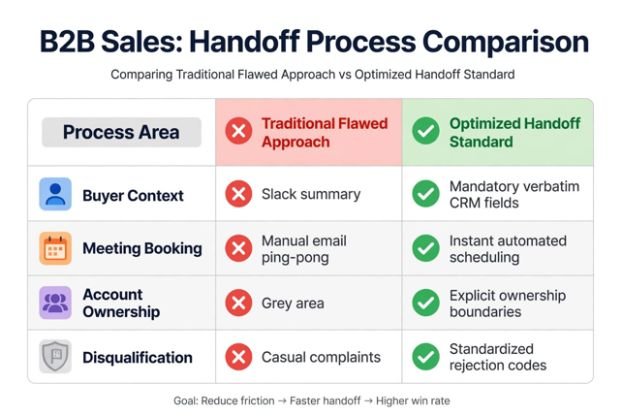
| Point of Friction | Traditional Flawed Approach | Optimized Handoff Standard |
| Buyer Context | SDR sends high-level summary via Slack | Mandatory verbatim CRM fields populated |
| Meeting Booking | Manual email ping-pong across days | Instant automated scheduling at point of qualification |
| Account Ownership | Grey area until the first demo completes | Explicit ownership boundaries defined by CRM stages |
| Disqualification | AE complains casually to sales leadership | Standardized drop-down rejection codes within 24 hours |
Building the 4-Stage Sales Qualification Gate
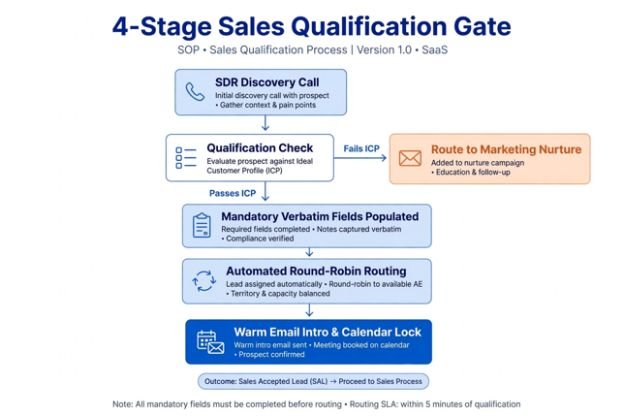
A clean qualification gate prevents unqualified tire-kickers from clogging closing calendars. I require our SDRs to validate four pillars: ICP fit, pain verification, timeline trigger, and meeting intent.
[SDR Discovery Call]
│
▼
[Qualification Check] ──(Fails ICP)──► Route to Marketing Nurture
│
▼ (Passes ICP)
[Mandatory Verbatim Fields Populated]
│
▼
[Automated Round-Robin Routing]
│
▼
[Warm Email Intro & Calendar Lock]
Enforcing a Verbatim Data Schema
I banned open-text paragraphs in our Salesforce Sales Cloud configurations. SDRs must fill out standardized, required fields before the system unlocks account conversion. The most valuable field is “Primary Pain (Verbatim).” I do not want an SDR’s interpretation of the problem; I want the prospect’s exact phrasing.
| CRM Field | Required Inputs | Example Record |
| Primary Pain (Verbatim) | Direct quote describing business bottleneck | “Month-end reconciliation takes four full days because Stripe and NetSuite do not talk.” |
| Compelling Event | Why the prospect agreed to meet now | Finance team headcount freeze announced for next quarter; manual entry unsustainable. |
| Current Tech Stack | Active vendor tools and broken points | NetSuite, Stripe, Zapier. Zapier workflows regularly break under volume. |
| Key Decision Stakeholders | Names, titles, and buying influence | VP Finance (evaluator, attending), CFO (budget sign-off, loop in post-discovery). |
Automated Routing and Calendar Mechanics
Eliminate manual round-robins. Use automated routing engines to instantly deliver calendar availability based on territory, segment, and account tier. The SDR books the meeting directly on the AE’s calendar while still speaking with the buyer.
Immediately following the booking, the SDR sends a joint email introduction. This email cc’s the AE, confirms the scheduled time, states the agreed-upon agenda, and reminds the prospect of the exact challenge being addressed.
Setting Ironclad Service Level Agreements
Disputes between SDRs and AEs destroy team culture. SDRs claim AEs drop the ball on valid meetings, while AEs complain that SDRs pass trash to inflate their numbers. To align incentives, revenue leaders must carefully structure tiered sales commission plans tied directly to pipeline milestones.
Clear operational service level agreements (SLAs) resolve this friction entirely. Research from HubSpot reveals that strict cross-team SLAs correlate directly with higher sales target attainment.
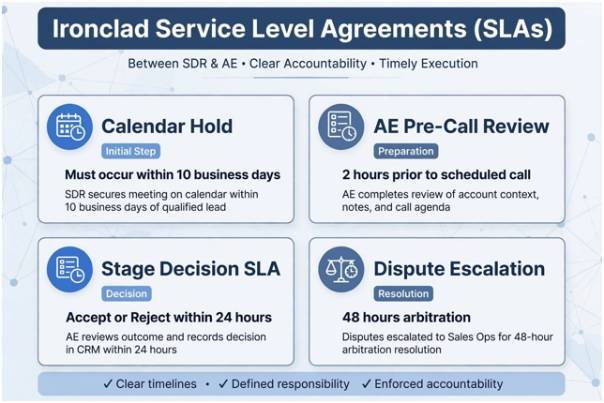
| SLA Parameter | Operational Rule | Non-Compliance Consequence |
| Calendar Hold | Meeting must occur within 10 business days of booking | Opportunity auto-returns to SDR re-engagement list |
| AE Pre-Call Review | Account and notes reviewed 2 hours prior | Escalation to sales manager |
| Stage Decision SLA | Accept or Reject within 24 hours post-call | Opportunity automatically locks in CRM |
| Dispute Escalation | 48 hours for sales leadership arbitration | Bi-weekly review of conversion metrics |
The 24-Hour Stage Acceptance Rule
Within 24 hours of the discovery call, the AE must mark the opportunity as Stage 1 (Accepted) or Disqualified (Rejected). An AE cannot leave an opportunity lingering in qualification limbo. Once accepted, pipeline credit officially logs for the SDR, and full deal velocity tracking begins for the AE.
Managing Lead Disputes Fairly
If an AE rejects an opportunity, they cannot simply write “poor fit.” They must select a predefined rejection code in the CRM:
- Sub-ICP Size/Revenue: Company metrics fall below tier boundaries.
- No Valid Authority: Contact has zero influence or access to buying power.
- Timeline Mismatch: Evaluation delayed beyond a 12-month horizon.
- Ghost / Unresponsive: Prospect missed scheduled session despite two reschedule efforts.
If an SDR feels a rejection was unfair, sales management arbitrates the call recording. Transparent rules eliminate finger-pointing.
Running the Joint Discovery Call
A warm transition does not end when the calendar invite sends. For high-value enterprise accounts, I insist on a five-minute co-pilot model. The SDR attends the first five minutes of the discovery call to introduce the AE, reinforce rapport, and step back.
The AE must immediately acknowledge the SDR’s briefing. Opening with: “Our SDR briefed me on your month-end reconciliation challenges, so you will not need to repeat yourself.
Did we miss anything critical?” instantly proves internal alignment. As noted in business management studies from the Harvard Business Review, establishing credibility early in professional interactions drastically reduces buyer risk aversion.
Stop the Pipeline Blame Game
A winning handoff process is not a matter of goodwill; it is an engineered operational workflow. Standardize your CRM intake fields, enforce strict 24-hour review windows, and mandate that AEs validate existing notes rather than restarting discovery from scratch. When you protect your buyer’s time, your conversion metrics follow.
Audit your current pipeline leakages today. Export your last fifty disqualified SDR-generated opportunities, categorize the failure points, and install the verbatim handoff framework immediately.
Frequently Asked Questions
1. What is the account executive and sdr handoff process?
It is the structured protocol for transferring a qualified prospective buyer from an outbound prospecting representative to an account executive for discovery and closing.
2. How long should an AE take to accept an SDR handoff?
An account executive should formally accept or reject a handed-off lead within 24 hours of completing the initial discovery meeting.
3. What causes an SDR-to-AE handoff to fail?
Handoffs typically fail due to unstructured CRM notes, lack of clear qualification criteria, and forcing the buyer to repeat information.
4. Should SDRs attend the AE discovery call?
For mid-market and enterprise deals, SDRs should attend the first five minutes to introduce the AE, confirm context, and transfer rapport.

One thought on “Account Executive and SDR Handoff Process: My Flawless SOP”