
Most competitive battlecards gather digital dust in Google Drive because product marketers build them for comprehensive study rather than mid-call execution. If an account executive cannot parse a counter-argument within five seconds while a prospect is mid-sentence, the resource has failed.
Knowing how to build a sales battle card for reps requires prioritizing operational scannability, behavioral reframes, and brutal competitive honesty over exhaustive feature tables.
I cut our own card adoption friction in half by stripping out generic marketing summaries and enforcing a strict, one-view field standard.
Sourcing Unfiltered Field Intelligence
A battlecard built strictly on a competitor’s marketing website reflects how they want to be seen, not how they actually sell. Actionable cards pull insights directly from pipeline battlegrounds.
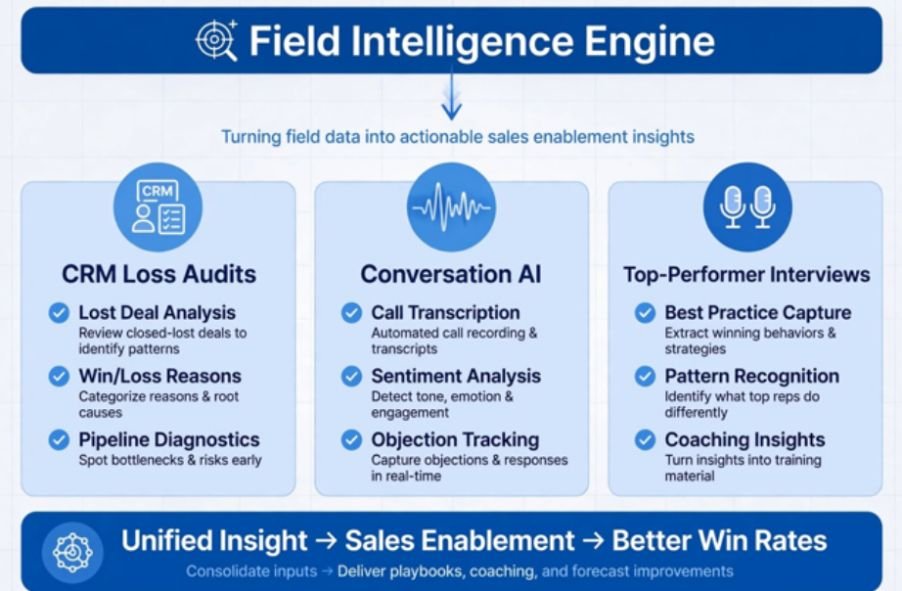
[Field Intelligence Engine]
│
┌────────────────────────────┼────────────────────────────┐
▼ ▼ ▼
[CRM Loss Audits] [Conversation AI] [Top-Performer Interviews]
– Filter competitor tags – Pull exact buyer quotes – Document native reframes
– Identify drop-off stages – Spot competitor traps – Map actual win themes
Mine Lost Deals and Call Recordings
Start inside your CRM pipeline. Pull win-loss notes from the past two quarters where the competitor was explicitly tagged. Look for patterns in sales stages: did prospects bail during the initial discovery, or did deals stall at technical evaluation?
Next, run searches across your conversational intelligence platform. Gong Labs research reveals that competitive conversations correlate with longer deal cycles and lower close rates when reps address competitors reactively. Listen for the precise language buyers use. When a prospect says an interface feels “clunky” or “heavy,” use those exact words in your card.
Run Top-Performer Debriefs
Interview the reps closing business against the rival. Skip the reps who win purely on price. Focus on reps who win at full margin. Ask what single question pivots the prospect away from the competitor’s main strength.
Document their actual conversational phrasing. These field notes become the foundation of your live call talk tracks and reinforce proven b2b sales demo closing techniques when buyers demand side-by-side technical proof.
The Core Anatomy of an Actionable Competitive Cheat Sheet
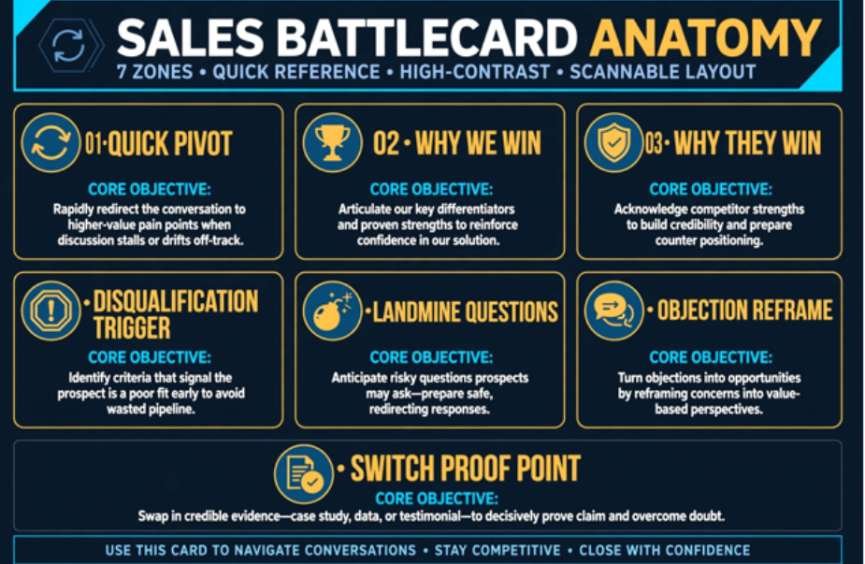
Every high-performing battlecard balances offensive differentiation with defensive posture. A single card must cover seven core operational zones.
| Battlecard Zone | Core Objective | Field Example |
| Quick Pivot | Defuse competitor mentions instantly | “They run a great entry-level tool; teams upgrade to us once custom reporting breaks.” |
| Why We Win | Identify business outcomes | Accelerate time-to-value by 40% via automated ERP syncing. |
| Why They Win | Acknowledge their actual edge | Budget pricing under 50 seats; rapid plug-and-play setup. |
| Disqualification Trigger | Stop reps wasting pipeline time | Buyer demands on-premise hosting (Competitor’s primary architecture). |
| Landmine Questions | Plant structural doubts early | “How many paid add-ons are needed to pull real-time audit logs?” |
| Objection Reframe | Neutralize common traps | Address their lower pricing by spotlighting higher implementation consulting fees. |
| Switch Proof Point | Third-party validation | 200-seat switch story: cut pipeline sync latency from three days to zero. |
Outcome-Driven Value and Strategic Concessions
Never list raw features under your advantage section. If you write “automated workflow engine,” your rep recites a buzzword. Write “removes manual record updates, saving ops teams ten hours per week.”
Equally critical is detailing where your competitor excels. When a rep pretends a competitor has no strengths, they incinerate buyer trust. Acknowledge the competitor’s strengths openly, then pivot immediately to your ideal customer profile.
Establishing disqualification criteria early provides critical ways to reduce enterprise sales deal slippage by keeping reps from chasing bad-fit prospects.
Trap-Setting Questions and Talk Tracks
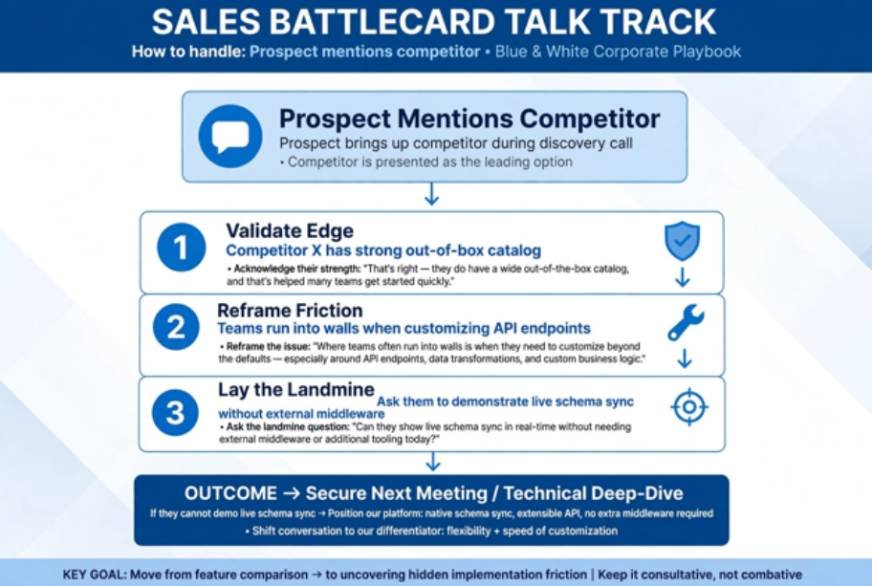
Train your reps to guide the evaluation using strategic landmine questions. These questions teach buyers how to inspect vendor capabilities during demos.
[Prospect Mentions Competitor]
│
▼
[1. Validate Edge] ────────► “Competitor X has a strong out-of-the-box catalog.”
│
▼
[2. Reframe Friction] ─────► “Teams run into walls, though, when customizing API endpoints.”
│
▼
[3. Lay the Landmine] ─────► “Ask them to demonstrate a live schema sync without external middleware.”
If your competitor requires paid professional services for routine data imports, equip your prospect to ask: “Can you walk me through importing custom schema changes on the standard tier without third-party consultants?” The competitor will have to backpedal during their own demonstration.
Formatting for Mid-Call Scannability
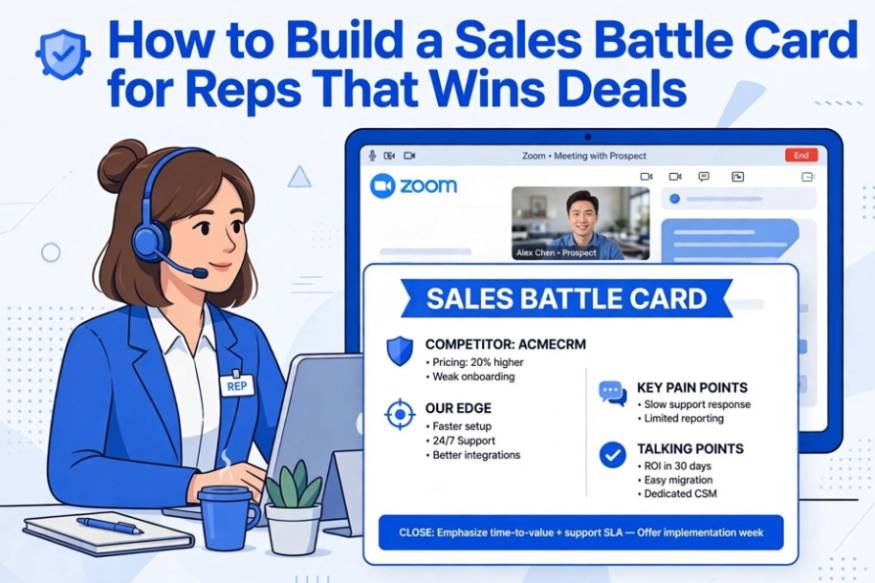
Reps cannot read dense paragraphs during a live Zoom meeting. Structure every battlecard around immediate visual recognition.
Plaintext
================================================================================
COMPETITOR: Apex Cloud | PROFILE: Mid-Market ERP | UPDATED: Q3
================================================================================
PIVOT: “Apex handles entry-level accounting well; we solve cross-border entity consolidation.”
——————————————————————————–
WE WIN ON: Real-time multi-currency settlement (Zero manual journal runs)
THEY WIN ON: Sub-$10k departmental deployments (No dedicated IT needed)
DISQUALIFY IF: Single-entity US company with zero international footprint
——————————————————————————–
LANDMINE: “Can you configure multi-entity consolidation without professional services?”
——————————————————————————–
TOP OBJECTION: “Apex is 40% cheaper.”
TALK TRACK: “Their initial license is lower, but they charge for API call volume.
Factor in transaction fees, and year-one TCO is higher.”
——————————————————————————–
PROOF POINT: FinTech Corp dropped Apex after $30k in unexpected API surcharges.
================================================================================
Use stark visual contrast, bold headers, and high-impact phrases. Enablement analysis from HubSpot’s sales studies indicates reps retain short, punchy responses far better than detailed operational runbooks. Keep every module strictly visible on a single monitor view.
Field Integration and Iteration Cadence
A battlecard hidden in a nested folder will not get used. Embed competitive modules inside deal records within your CRM. When an account executive marks a competitor on an active opportunity, surface the corresponding card directly inside the opportunity layout.
Competitive intelligence decays quickly. According to Gartner’s sales enablement benchmarks, market messaging cycles shift every few quarters as vendors launch features and adjust pricing.
Quarterly Audit Cadence:
Week 1: Run win/loss CRM pipeline reports by competitor
Week 2: Review Gong/Chorus transcripts for new competitor objections
Week 3: Update pricing, landmine questions, and talk tracks
Week 4: Re-publish cards inside CRM and run a 15-minute rep drill
Assign direct ownership of each card to a product marketer or dedicated sales engineer.
How to run effective weekly sales one-on-ones can help sales leaders create a consistent forum for reviewing rep performance, discussing competitive challenges, and turning field feedback into specific coaching actions.
Run quarterly review sprints to update pricing changes, feature deprecations, and new packaging tiers.
Frequently Asked Questions
1. How long should a sales battlecard be?
A sales battlecard must fit on one single screen or page so reps can reference information mid-call without scrolling.
2. How often should sales battlecards be updated?
Audit cards quarterly to ensure pricing structures, customer switch stories, and product capabilities remain accurate.
3. What is the most critical element of a battlecard?
The landmine question is the most critical element because it proactively shapes the prospect’s evaluation criteria.
4. Should you share battlecards directly with prospective buyers?
No, battlecards are confidential internal playbooks containing proprietary competitive positioning and negotiation strategies.
Ditch the Feature Matrix Before Your Competitor Takes Your Pipeline
Feature checklists commoditize your product and turn high-margin sales into pricing shootouts. Build cheat sheets that arm reps with strategic questions, outcome metrics, and crisp talk tracks.
Take your top competitor today, strip out the feature matrix, and replace it with three landmine questions and a single disqualification trigger. Test that single card with two senior reps this week, iterate on their feedback, and watch your win rates climb.