

Most software sales reps butcher the final five minutes of a product presentation. They sprint through product features, run out of time, and mumble: “So, what did you think?”
That passive question kills conversion rates. After leading hundreds of enterprise software presentations, I learned that mastering b2b sales demo closing techniques is not about forcing an immediate signature.
Enterprise buyers almost never sign contracts on a first call. The real objective of your demo close is simple: lock down an indisputable, calendar-confirmed commitment for the next stage of the procurement cycle.
If your demo ends without a scheduled meeting on both calendars, your deal has entered the pipeline graveyard.
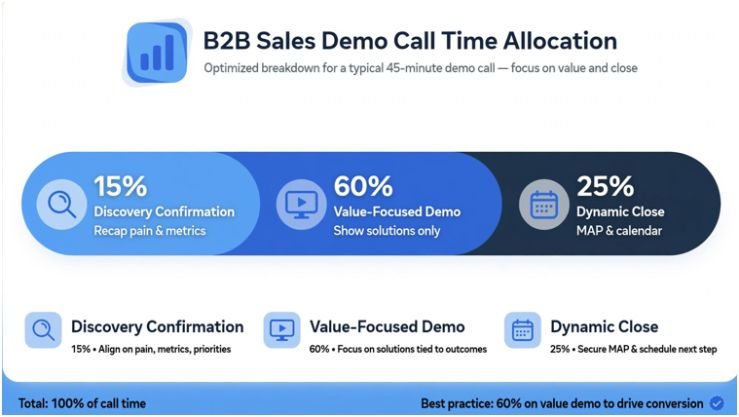
+————————————————————————-+
| DEMO CALL TIME ALLOCATION |
| |
| [ Discovery Confirmation ] [ Value-Focused Demo ] [ Dynamic Close] |
| 15% 60% 25% |
| (Recap pain & metrics) (Show solutions only) (MAP & calendar) |
+————————————————————————-+
Rethinking the Demo Close: Why Traditional Tactics Stall Deals
Traditional transactional sales playbooks preach high-pressure closing maneuvers. In complex B2B sales, those old-school tactics backfire immediately.
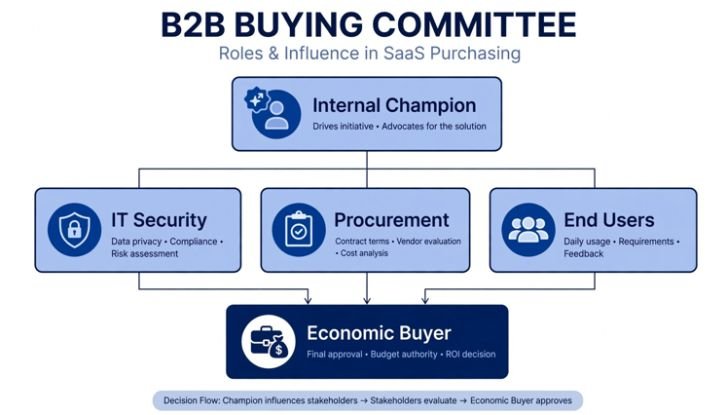
Enterprise software purchasing involves distributed risk. According to enterprise sales research from Gartner, a typical enterprise software purchase involves six to ten distinct stakeholders, each armed with competing priorities and individual veto power.
Forcing an aggressive close on a single department manager ignores the economic buyer, IT security, legal, and compliance teams waiting in the background.
+————————-+
| Internal Champion |
+————+————+
|
+———————–+———————–+
| | |
+——v——+ +——v——+ +——v——+
| IT Security | | Procurement| | End Users |
+————-+ +————-+ +————-+
| | |
+———————–+———————–+
|
+————v————+
| Economic Buyer |
+————————-+
When you understand this dynamic, your pipeline forecasts become predictable. Teams must benchmark their conversion targets against established b2b sales pipeline stage conversion benchmarks rather than treating a completed product walkthrough as an assured win.
Shifting from Single Buyer Pressure to Buying Committees
Instead of attempting to close the account during the demo, close the prospect on becoming your co-collaborator. You need your internal champion to actively sell on your behalf once you log off Zoom. When you shift your mindset from closing an order to constructing an operational bridge, the prospect lowers their defenses.
4 Proven B2B Sales Demo Closing Techniques That Win Mid-Market and Enterprise Deals
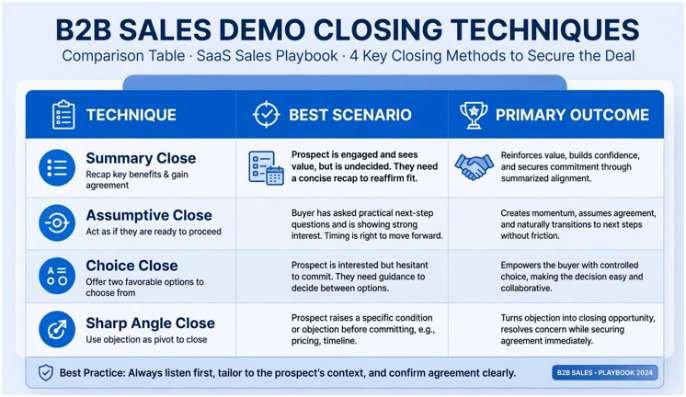
I rely on four core closing methodologies. Each technique serves a precise scenario depending on prospect engagement and organizational complexity.
+———————+——————————-+————————-+
| TECHNIQUE | BEST SCENARIO | PRIMARY OUTCOME |
+———————+——————————-+————————-+
| 1. Summary Close | High-pain, technical evaluations| Direct metric validation|
| 2. Assumptive Close | Strong rapport, clear intent | Operational launch date |
| 3. Choice Close | Hesitant champion | Low-friction path |
| 4. Sharp Angle Close| High-demand concession request| Reciprocal commitment |
+———————+——————————-+————————-+
1. The Summary Close: Anchoring Pain to Financial ROI
The Summary Close connects demonstrated product capabilities directly back to the business pain uncovered during your discovery session. It strips away technical jargon and grounds the solution in commercial outcomes.
- When to deploy: Ideal for complex platforms where the buyer can easily lose sight of ROI amidst feature overviews.
- Tested Script: “Based on our conversation today, automating your data pipeline eliminates roughly 14 hours of manual reconciliation every week. That fixes the reporting latency you flagged between billing and operations. Does this setup solve the primary bottleneck your team is facing?”
2. The Assumptive Timeline Close: Operationalizing Next Steps
The Assumptive Close ignores the hypothetical question of if the prospect will buy and focuses entirely on how execution occurs. You treat the partnership as a natural conclusion based on technical fit.
- When to deploy: Use this when the champion nods along, asks about implementation resources, or actively validates functional compatibility.
- Tested Script: “Since the platform supports your single sign-on and database structures out of the box, our typical integration takes two weeks. If we want your team trained before quarter-end, we should complete our security onboarding by the 15th. Shall we schedule the technical scoping call for this Thursday at 2 PM?”
3. The Alternative Choice Close: Eliminating Friction
Decision paralysis frequently stalls enterprise momentum. The Alternative Choice Close removes ambiguous open-ended questions like “Where should we go from here?” and replaces them with two distinct, positive forward paths.
- When to deploy: Best applied when dealing with analytical champions who want to advance but seem overwhelmed by organizational red tape.
- Tested Script: “We have two practical paths forward. We can run a 30-minute technical architecture review with your head of infrastructure this Wednesday, or we can assemble a commercial scope review with your VP on Friday morning. Which option makes the most sense for your calendar?”
4. The Sharp Angle Close: Monetizing Concessions
Prospects routinely request discounts, bespoke service agreements, or accelerated rollouts near the end of a call. Never grant a concession without securing an immediate trade. Insights from the Harvard Business Review emphasize that unreciprocated concessions degrade deal margins and diminish perceived vendor authority.
- When to deploy: Deploy when an enterprise prospect requests custom engineering, extended trial access, or tiered discounting.
- Tested Script: “We can definitely allocate our implementation engineers to handle that custom API migration within your requested 30-day window. If I secure executive approval for those resources by tomorrow afternoon, can you commit to finalizing legal and compliance review by the end of next week?”
Continuous Trial Closes: Uncovering Latent Friction Early
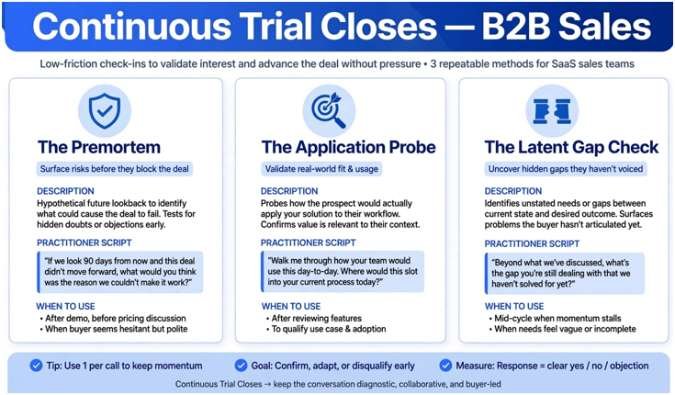
A closing technique executed in the final two minutes will fail if unaddressed objections linger below the surface. Successful demo execution requires continuous validation throughout the presentation.
I integrate three trial closing prompts across the middle 30 minutes of every call:
+———————+—————————————————+
| TRIAL CLOSE TYPE | PRACTITIONER SCRIPT |
+———————+—————————————————+
| The Premortem | “If we look ahead six months and this rollout has |
| | stalled internally, what caused it?” |
| | |
| The Application Probe| “How do you see your day-to-day team using this |
| | analytics module during month-end closes?” |
| | |
| The Latent Gap Check| “What critical capability did you expect to see |
| | today that we haven’t touched on yet?” |
+———————+—————————————————+
By uncovering technical blockers, budget constraints, or organizational politics halfway through the call, you address objections before they derail your final close.
The Modern Demo-to-Close Execution Matrix
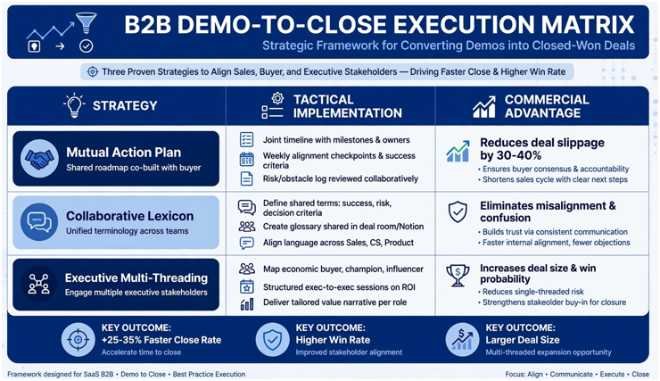
Modern SaaS sales require structured alignment between buyers and sellers. High-growth sales organizations rely on collaborative execution frameworks to shorten sales cycles. Published sales research from HubSpot shows that formalizing sales stages and mutual expectations dramatically improves win rates across competitive evaluations.
I manage this alignment using a standardized framework across all mid-market and enterprise opportunities:
+———————–+———————————+————————-+
| STRATEGY | TACTICAL IMPLEMENTATION | COMMERCIAL ADVANTAGE |
+———————–+———————————+————————-+
| Mutual Action Plan | Establish a joint, dated project| Replaces guesswork with |
| (MAP) | roadmap covering IT, legal, and | shared operational |
| | security deliverables. | accountability. |
| | | |
| Collaborative Lexicon | Replace “you” and “your team” | Removes vendor/buyer |
| | with “we” and “our joint | friction; establishes |
| | timeline.” | consultative parity. |
| | | |
| Executive Multi- | Pair internal executive sponsors| Neutralizes champion |
| Threading | with buyer leadership early in | departure risk; aligns |
| | technical validation. | budget authority. |
+———————–+———————————+————————-+
When building out your regional go-to-market motions and territory coverage through disciplined b2b sales territory planning, this closing framework ensures consistent pipeline execution across every rep on your team.
Stop Pitching Features: My 24-Hour Post-Demo Playbook
Securing a verbal agreement on a call means nothing if follow-through falters. Within 24 hours of completing a product demo, I execute three specific actions:
+————————————————————————-+
| 24-HOUR POST-DEMO CADENCE |
| |
| [ Step 1: Hour 0-2 ] –> Send interactive MAP & calendar invite |
| [ Step 2: Hour 4-8 ] –> Deliver a 90-second customized video recap |
| [ Step 3: Hour 12-24 ] –> Equip champion with single-page business |
| case deck for internal stakeholders |
+————————————————————————-+
- Send the Interactive MAP: I email a shared project document containing explicit names, dates, and ownership items agreed upon during the close.
- Deliver a Micro-Demo Video: I record a 90-second, high-level summary video reviewing the exact ROI metrics discussed. Your champion will forward this asset directly to the CFO.
- Lock the Calendar Invite Immediately: Never send generic follow-up emails without an attached, accepted calendar event. If the prospect fails to accept the invite within 24 hours, address the calendar gap immediately to maintain deal velocity.
Frequently Asked Questions About B2B Sales Demo Closing Techniques
1. What is the most effective close for a complex SaaS demo?
The Assumptive Timeline Close paired with a formal Mutual Action Plan delivers the highest enterprise win rates.
2. How do you close a demo when the economic buyer is absent?
Deploy the Alternative Choice Close to lock in a dedicated, high-level briefing directly with the economic buyer.
3. What should I do if a prospect says “send me the recording”?
Acknowledge the request, send a short 2-minute executive highlight reel, and require a calendar-confirmed review meeting to assess stakeholder feedback.
4. When is the right time to begin closing during a sales demo?
Closing begins during discovery by tying every feature demonstrated to a quantified metric, followed by continuous trial closes throughout the call.
One thought on “B2B Sales Demo Closing Techniques: How I Secure Enterprise Commitments”